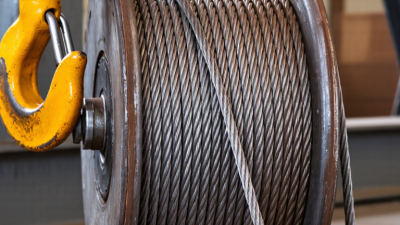
What Are the Top Crane Hoisting Wire Rope Types in 2026?
In 2026, the best crane hoisting wire rope is not simply the strongest option on a product sheet. It must suit the crane, reeving system, sheaves, lifting cycle, and working environment. A rope that performs well on a slow warehouse hoist may wear quickly on a busy construction crane. Details matter.
Wire-rope specialist Wolfgang Verreet’s technical work offers a useful selection principle, paraphrased here: “Match rope construction to the duty cycle, not just the catalog label.” This guide compares common constructions, including 6×19 and 6×36 ropes, rotation-resistant designs, and compacted strands. Each brings trade-offs in flexibility, abrasion resistance, rotation control, and service life. There is no universal winner.
Look beyond breaking strength. Check the rope’s core, lay, diameter, and compatibility with the crane maker’s specifications. Consider tight sheaves, repeated bending, side pull, and exposure to moisture or grit. A rope may look sound at ground level while showing broken wires near a termination or drum. Small clues count.
The sections ahead explain where each type can fit, what to inspect, and which details deserve a second look. They are not substitutes for equipment documentation or a qualified inspection. Real conditions vary. Even a sound comparison has limits.
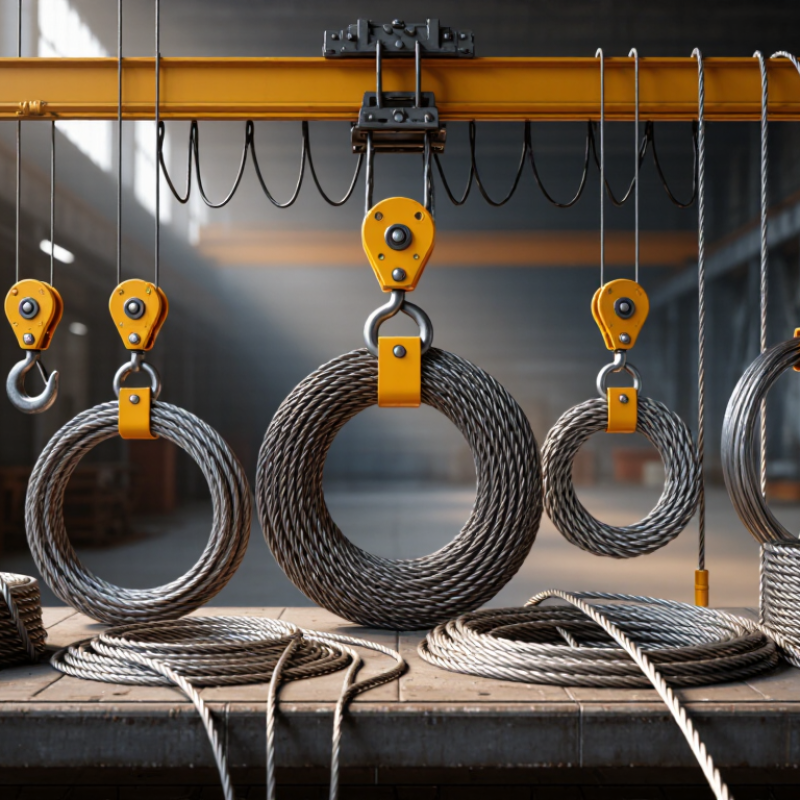
What Is a Crane Hoisting Wire Rope?
A crane hoisting wire rope is a flexible steel lifting line. It consists of individual wires twisted into strands, then laid around a central core. The core may be fiber or steel. During a lift, the rope carries force between the crane drum, sheaves, and suspended load. Its construction affects flexibility, resistance to crushing, and rotation under load. Small details matter: a rope that bends repeatedly over a sheave experiences different stresses from one wound tightly onto a drum.
The U.S. Bureau of Labor Statistics reported 5,283 fatal work injuries across all industries in 2023. That figure is not specific to cranes or wire rope, but it underscores why lifting equipment needs disciplined inspection. ISO 4309:2017 sets out inspection and discard guidance for steel wire ropes, including checks for broken wires, diameter loss, corrosion, and deformation. A rope’s appearance alone cannot confirm its remaining capacity. Inspectors need the rope’s construction, service history, and the crane manufacturer’s requirements. Even then, judgments can be difficult; wear is not always evenly distributed. A hidden damaged section may be easy to miss.
How Are Crane Hoisting Ropes Classified?
Crane hoisting wire ropes are commonly classified by construction, core type, and rotation behavior. Construction describes how wires form strands and how strands wrap around the core. Examples include 6×19 and 6×36 constructions; the numbers indicate strand and wire counts, though exact arrangements vary. More wires can provide a smoother running surface, while larger outer wires may better tolerate abrasion. The right balance depends on the sheaves, drum, load, and operating conditions.
Core type is another practical distinction. A fiber core offers flexibility and can hold lubricant, while an independent wire-rope core supports the strands under higher crushing pressure. Steel cores are often considered when ropes face heavy loads or multilayer spooling. Details matter. Rope lay also describes the direction in which wires and strands twist. Regular lay is generally easier to handle, while lang lay can offer greater abrasion resistance but may be more prone to rotation or handling issues.
Rotation-resistant ropes use multiple strand layers arranged to counter twisting under load. They may suit applications where a freely rotating load creates risk, but they still require compatible reeving and careful installation. Ropes are also described by finish, lubrication, and grade, depending on the specification system. Classification alone cannot select a safe rope: check the crane manufacturer’s requirements, rope diameter, reeving pattern, and inspection history. This is where a tidy category chart can mislead; real wear rarely follows the chart perfectly.
Which Wire Rope Constructions Are Commonly Used?
Crane hoisting ropes commonly use 6×19 or 6×36 constructions. The notation describes six strands arranged around a core; the numbers identify nominal wire-count families. The Wire Rope Technical Board’s Wire Rope Users Manual explains why these constructions behave differently: larger outer wires generally resist abrasion, while more wires can improve flexibility. That difference matters at the sheave. A rope bending repeatedly over a small sheave may fatigue sooner, even when its rated strength looks suitable.
Six-strand ropes with an independent wire-rope core (IWRC) are common where a steel core helps support the strands under load. Fiber cores offer greater flexibility, but may be less suited to heat or crushing pressure. Rotation-resistant ropes use multiple strand layers laid in opposing directions, helping limit load-induced twist when a freely suspended block turns. Compacted strands can provide a smoother outer surface and a denser rope, though they are not a fix for poor sheave alignment. The trade-off is not always neat. The Wire Rope Technical Board’s manual provides construction guidance, while ISO 4309:2017 sets inspection and discard criteria, including assessment of broken wires and diameter reduction. In practice, check the crane maker’s specified rope, reeving, and sheave dimensions before choosing a construction. A rope that looks sound may still need closer inspection.
How Do Rope Cores and Lay Patterns Affect Performance?
A rope core quietly shapes how a crane rope behaves under load. An independent wire rope core (IWRC) supports the strands and usually resists crushing better on drums with multiple layers. It can also tolerate more heat than a fiber core. A fiber core often bends more easily and can provide useful flexibility, but heat and severe crushing may shorten its service life. The right choice depends on the rope construction, sheave size, duty cycle, and equipment maker’s specifications. There is no universal winner.
Lay pattern matters, too. In regular lay, the outer wires and strands run in opposite directions. This construction tends to handle more steadily and resist kinking. In lang lay, they run in the same direction, exposing more wire surface to abrasion and often improving flexibility. But lang lay may be more prone to rotation, so it may not suit every freely suspended load. Rotation-resistant ropes use carefully arranged layers to limit torque. Their performance still depends on correct reeving and compatible hardware.
Watch the details. A rope that looks robust can wear quickly in a tight or damaged sheave groove. On site, check for flattened sections, broken wires, and uneven winding; small changes can be easy to miss. I would not select by core or lay alone. Compare the rated construction with the crane’s manual, load behavior, and inspection findings. Even then, real operating conditions can surprise you.
How Can You Choose the Right Hoisting Rope in 2026?
Choosing a hoisting rope starts with the lift, not the catalogue.
Record the load, reeving pattern, drum and sheave diameters, lift speed, and duty cycle. A 6×36 rope often bends more flexibly than a 6×19 construction, while rotation-resistant ropes help control twisting on long, multi-part lifts. Those are tendencies, not guarantees. Match the rope’s construction and core to the crane maker’s specifications and the actual reeving system. Check the required minimum breaking force, too. A larger number alone does not make a rope suitable.
Environment changes the choice. Galvanized wire can help in damp conditions; a compacted rope may offer greater wear resistance, but sheave compatibility still matters. ISO 4309:2017 assesses discard conditions by rope construction and factors such as broken wires, diameter loss, corrosion, and deformation. It does not provide one universal broken-wire limit. Inspect against the applicable criteria and keep baseline diameter measurements. A useful risk reminder: the U.S. Bureau of Labor Statistics reported 5,283 fatal work injuries across all industries in 2023; that figure is not crane-specific, but it reinforces why inspection cannot be an afterthought. Keep the rope certificate and inspection history together. Real operating conditions are rarely tidy. Recheck your assumptions when the rope sees shock loading, abrasive dust, or repeated short lifts.